

The majority of the public do not want NHS privatisation, because it is bad for patients, bad for NHS staff, and bad for the future of the NHS.
We will do everything we can to oppose it.
Introduction
EveryDoctor has been campaigning against NHS privatisation for several years now, because it is bad for patients, bad for NHS staff, and bad for the future of the NHS itself. Politicians and media outlets often discuss NHS privatisation as if it is a future problem, but this is wrong. NHS privatisation exists right now, it is extensive, and we think it is really important that everyone finds out what is happening.
We began by building a map showing the NHS outsourcing happening across the UK, and we are now focusing on specific aspects of the situation, to reveal what’s going on. In 2023, we investigated the PFI debts held by NHS trusts, we explored the links between many UK politicians and the private healthcare sector and recently we created an updated map, allowing people to find examples of NHS outsourcing happening in their constituency.
Research
We have now turned our attention to the amount of public money being spent on private mental health companies. In recent years there have been significant NHS bed cuts, which means there are not enough NHS hospital beds. This means that the NHS is paying huge sums of money to private mental health hospitals to look after NHS patients.
We knew that this was a big problem, and so we decided to investigate.
Astonishingly, we discovered there was no way to know exactly how much money the NHS spends outsourcing beds for mental health patients because the figures haven’t been published.
To make matters worse, there were no shortcuts to obtaining the spending figures. When we looked into it, it still wasn’t clear which organisations had the information we needed – we couldn’t be sure if the 42 Integrated Care Boards in England were responsible, or whether the individual mental health trusts would have the data. We realised we’d have to get in touch with every single Integrated Care Board and Mental Health Trust in England individually to get answers to our questions – no mean feat.
“More than £1.4 billion had been spent on private mental health beds between 2019 and 2024”
We sent Freedom of Information requests to every single trust and ICB asking them to tell us how much they’ve spent on mental health beds every year since 2019 and which private healthcare companies they used.
It took months to obtain their responses, and then weeks of work for us to read through the mountain of responses we received and manually input all the sums into a dataset. When we finally had all the data in front of us, we were shocked by what it told us.
More than £1.4 billion had been spent on private mental health beds between 2019 and 2024 by the NHS in England. In that time, spending had risen by 68%. Not all the trusts and ICBs we contacted replied to us, so the true figure was likely higher.
Total spent by NHS mental health trusts and integrated care boards on private mental health beds in England
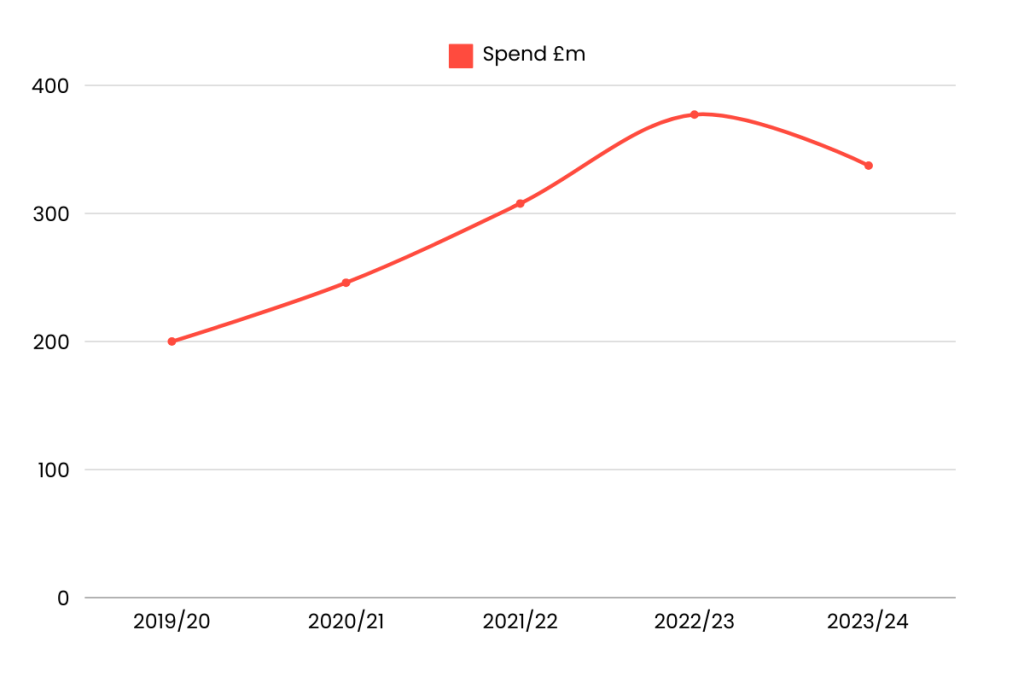
Some trusts told us their spending had more than doubled over five years. Surrey and Borders Partnership NHS Foundation Trust said it was spending ten times as much on private mental health beds in 2024 as it had in 2019. Lancashire & South Cumbria NHS Foundation Trust similarly told us it was spending jumped from £3.8m in 2019/20 to a staggering £40m in 2023/24. In Dorset, the mental health trust was spending just £800,000 on beds in 2019/20 but by 2023/24 this rose to £6.6m.
These eye-watering figures raised several questions: who were the private providers cashing in on the NHS’s shortage of mental health beds? And how much profit were they making?
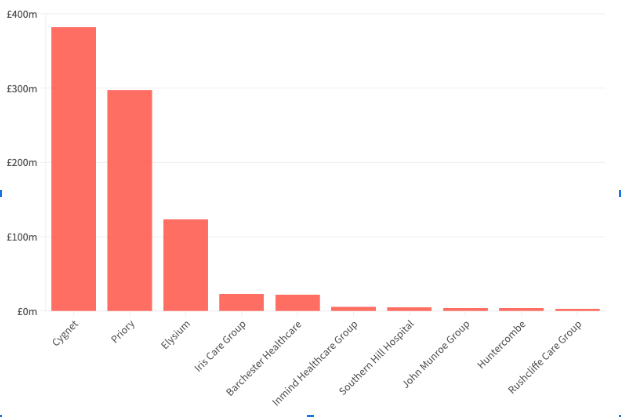
We dug deeper into the responses we received from the NHS and found that just three companies were taking the lionshare of public contracts for mental health beds.
Highest paid private providers of mental health beds to the NHS in England
Cygnet has faced its share of controversies over the care it provides to vulnerable patients. In 2019, at one private hospital run by the company, staff were filmed taunting, intimidating and repeatedly restraining patients with learning disabilities or autism by undercover reporters. That same year, a separate Cygnet mental health unit was banned from admitting new patients after an inspection uncovered numerous safety failings, one of which led to a resident committing suicide.
Despite those scandals, the NHS would pay Cygnet more than £382m to provide mental health beds for patients it couldn’t accommodate over the next five years. But just how much profit were providers like Cygnet making? To find out, we would have to take a closer look at the company’s annual financial statements.
Over the period between 2019 and 2022, the latest available accounts, the company reported profits of more than £84m. What was particularly staggering was just how much of those profits were going to its bosses. The company’s CEO saw his salary almost double from £625,000 to £1.2m between 2019 and 2021 and the highest paid directors received a total of £2.9m in share-based compensation during the same period.
“There’s this kind of ridiculous idea that by cutting beds you’re somehow saving money.”
Cygnet said it “relies on publicly funded entities in the UK such as the NHS, Clinical Commissioning Groups and Local Authorities for substantially all of its revenues” in its accounts. But because Cygnet provides a range of services for the NHS, we can’t know exactly how much of its profits – and what margin it makes – from providing mental beds.
When we looked at the accounts for the next two biggest private providers of mental health beds, the story was very similar.
The NHS paid the Priory, which is owned by the Dutch private equity firm Waterland, £297m for mental health beds between 2019 and 2024. The company’s mental health division, which relies on the NHS for most of its revenue, reported earnings before interest, taxes, depreciation, and amortisation of £176m between 2019 and 2020.
Elysium, the third biggest provider of mental health beds, which is ultimately owned by Australian multinational Ramsay Health Care, was paid £123m by the NHS. It reported profits of more than £174m and its CEO took home more than £1.7m between 2019 and 2021.
While private healthcare companies have been making healthy profits and their CEOs have been lining their pockets, the number of mental health beds in the NHS has been cut. In England, the NHS now has 5,700 fewer beds than it did in 2010 – a 24% decline.
Anne, a psychiatrist, who has worked in the health service for three decades, told us that the cuts were often framed as efficiency savings by bosses, but in fact had the opposite effect.
“There’s this kind of ridiculous idea that by cutting beds you’re somehow saving money when in actual fact the need is just the same, and you’re going to have to use out-of-area beds in the private sector, which is going to cost far, far more.
But that comes out of a different pot, and therefore in inverted commas, doesn’t count,” she said.
Anne didn’t want to be named because she feared that she could face repercussions for speaking critically about decisions taken to cut beds, and unfortunately this is a common problem, because it is often difficult for NHS staff to speak up openly about what is happening to the service.
Conclusion
As an organisation, EveryDoctor is committed to lifting the lid on what politicians are doing to the NHS. We will continue to explore aspects of privatisation, hold politicians to account, and raise public awareness throughout our incredible network of supporters.
The majority of the public do not want NHS privatisation, because it is bad for patients, bad for NHS staff, and bad for the future of the NHS. We will do everything we can to oppose it.